Likelihood of Confusion in the Era of Quiet Luxury
Why industry knowledge matters in the likelihood of confusion assessment: opposition proceedings under Turkish law, read through the quiet luxury moment.
By · Aysu K. Ergin
The legal profession, by its very nature, has always required an interdisciplinary body of knowledge extending beyond mere legal expertise. In a profession that cannot be considered independently from philosophy, literature, politics, economics, art, and numerous other fields. Trademark law in particular calls for a distinctive perspective; one that, in certain disputes, constitutes a crucial element of effective portfolio management.
Introduction and Framework of Opposition Proceedings
Under Turkish law, once a trademark application has successfully passed the formal examination stage, it is examined ex officio by the Turkish Patent and Trademark Office (“TPTO”) on the basis of absolute grounds for refusal. Upon the successful completion of such examination, the application is published in the Official Trademark Bulletin, which is issued twice monthly. Trademark applications published in the Bulletin may be opposed within a non-extendable period of 2 months from the date of publication. The criteria for opposing such published applications on the grounds of likelihood of confusion and/or association, based on a client’s prior registered trademark or earlier-filed trademark application in Türkiye, are set out under Article 6/1 of the Law No. 6769 on Industrial Property Code (“IPC”). Accordingly, in order to oppose a trademark application on the basis of likelihood of confusion with the Client’s prior rights, three conditions must be cumulatively satisfied:
- Similarity between the trademarks (visual – phonetic – conceptual)
- Similar/ identical goods and/or services
- Likelihood of confusion before the consumer point of view.
We will examine the critical importance of possessing a long-standing background and a forward-looking vision in the fashion industry for trademark protection strategies and portfolio management, particularly in relation to portfolios operating within the luxury goods and fashion sectors, with a specific focus on conceptual similarity assessments. Indeed, in certain cases, the longstanding use of earlier trademarks and their prominent collections, which may become deeply entrenched in the perception of the relevant public, gradually merge with the enhanced distinctiveness and reputation of the trademark itself with regard to the well-known status of trademarks. In this respect, a visionary perspective plays a significant role in presenting detailed and compelling arguments, particularly in the context of trademark dilution assessments.
This approach creates a particularly decisive impact in assessments of conceptual similarity and in the evaluation of dilution risks concerning well-known trademarks, enabling the identification of numerous applications that carry the potential to give rise to trademark infringement.
In the course of trademark protection practices for portfolios operating within the fashion industry, this framework should not be limited merely to knowledge of the Client’s registered trademarks, uses, design registrations, or, where applicable, copyright registrations before IP offices in Türkiye or worldwide. Rather, a broader perspective should be developed; one capable of identifying, particularly through conceptual similarity assessments, circumstances in which signs may give rise to a likelihood of confusion by evoking the signature and traditional stylistic identity of a fashion house, even in cases where no registered right exists in relation to the relevant element. In the ever-evolving and interdisciplinary fashion industry, which is connected with architecture, philosophy, literature, sociology, painting, music and many more other fields, the protection of intellectual and industrial property rights inevitably requires an unconventional approach and perspective.
General and Practical Examples
Set out below are several scenarios in which, the assessment of likelihood of confusion between signs, both in relation to registered and unregistered rights, may prove particularly decisive outcomes:
On another portfolio-management deadline: A Critical Period for UK Trademark Registrations.
- The “AROE” trademark and its unregistered “13” collection:
One of the emerging brands in Türkiye that has recently demonstrated significant commercial growth, “AROE”, is registered before the Turkish Patent and Trademark Office (“TPTO”) in class 25, under the registration no. 2022 017133 in the name of ANZOR KEMALOĞLU.
In December 2025, the “13” collection began to be publicly promoted and used on products under the designation “Trust13”:
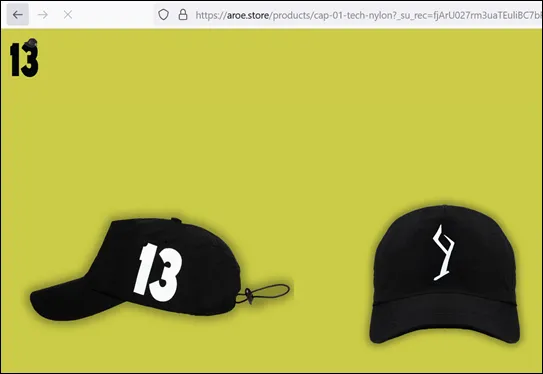
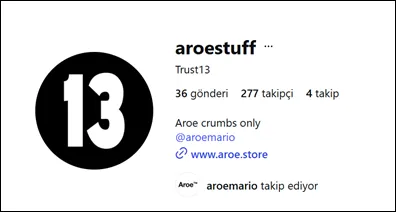
(https://www.instagram.com/aroestuff?utm_source=ig_web_button_share_sheet&igsh=ZDNlZDc0MzIxNw== )
In a trademark watch search conducted in respect of the AROE trademark, for which no registrations currently exist before the Turkish Patent and Trademark Office covering “13,” “Trust13,” “AROE 13,” or their figurative variations, the importance of comprehensive portfolio monitoring becomes evident in order to ensure that similar applications incorporating the number “13” are not overlooked.
By way of example, should an application such as “13ROE,” “A13OE,” or any similar variation in Class 25 be published in the Bulletin, the perspective of an established trademark portfolio and the commercial perception associated with the trademark would play a decisive role in the similarity assessment, particularly in relation to the conceptual convergence of the signs, as reflected in the arguments to be submitted before the Office.
- Maison Margiela and the iconic “Four White Stitches”:
The iconic “Four White Stitches” signature element of Margiela, recognizable wherever it appears and even reproduced on birthday cakes, is not registered as a trademark before the TPTO. Indeed, what renders these four white stitches truly iconic is precisely the fact that they enable the products to be recognized and their commercial origin to be identified without the use of any visible trademark, logo, sign, or brand name. This distinctive feature has become so closely associated with Margiela, that it was itself incorporated as an accessory element in the brand’s Spring/Summer 2026 fashion show
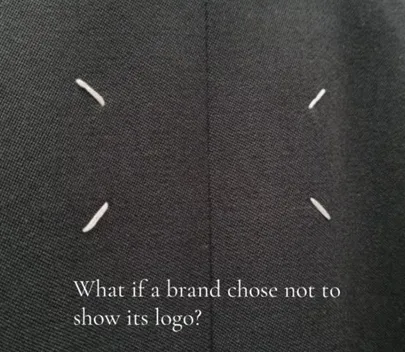


In such circumstances, a Class 25 trademark application consisting solely of four white stitch marks, once published in the Bulletin, would constitute grounds for opposition based on Margiela’s genuine right ownership. From the perspective of likelihood of confusion, where the four white stitches are combined with a sign similar to a prior Margiela trademark, the conceptual similarity between the marks would become a central factor in the assessment. Moreover, in certain cases, such use may even give rise to considerations of bad faith.
- LOUIS VUITTON and “No.7” in Commemoration of Virgil Abloh’s Seventh LV Collection
During the period in which Virgil Abloh served as Creative Director of Louis Vuitton, the “No 7” collection was launched in commemoration of the seventh collection designed by Abloh for LVMH’s Spring/Summer 2022 fashion show. The collection has since become one of LVMH’s signature references and is presently regarded as a valuable collector’s series:
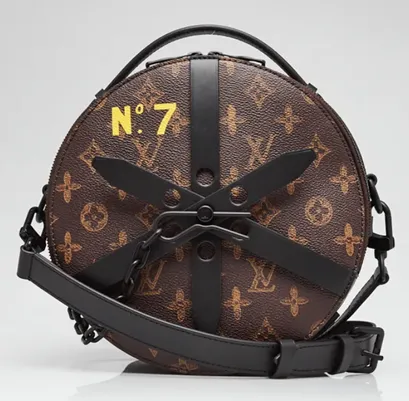
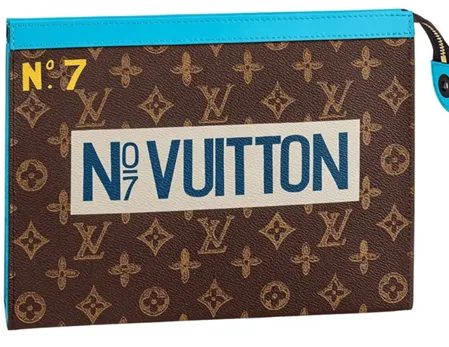
LVMH does not hold a trademark registration for “7” collection. However, such a portfolio management strategy would enable oppositions to be substantiated through arguments extending beyond mere visual similarity in cases where the iconic and registered “LV” logo is combined with the number “7.” By way of example, this may be illustrated through applications such as” ” (“7V”) detected in searches conducted on the TPTO database, which corroborate the present observations. In such cases, it may be argued that the signs conceptually approximate the iconic “No 7” collection of Louis Vuitton and that the origin-indicating function of the trademarks is thereby impaired.
- Margiela and the number “6”:
A similar situation arises in relation to Margiela’s iconic use of the number “6,” which, unlike the aforementioned examples, is also protected through trademark registrations:

“ ” no. 2021 074113 is registered in the name of MARGIELA.
By way of precedent supporting the foregoing explanations, searches conducted on the TPTO database reveal that Maison Margiela successfully opposed an application on the basis of its “MM6” trademarks, with the opposition being upheld on grounds of likelihood of confusion, against an application consisting solely of the element “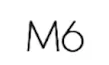 ” (“M6”).
- CHANEL and the wheat collection “Les Blés de Chanel”:
One of the most iconic signs associated with Chanel, despite not being protected through trademark registration, is its wheat-shaped accessory collection, rooting back to Gabrielle Coco Chanel’s inspired creativity.



Although Gabrielle Coco Chanel’s iconic wheat motif inspired by wheat fields is not currently protected through trademark registration, a wheat emblem combined with the “CC” logo or with a prior Chanel trademark registration/application, if published in the Bulletin, would not serve to differentiate the marks in some cases. On the contrary, when assessed as a whole, and particularly from a conceptual perspective, such use would even lead to render the signs similar.
Parody or Likelihood of Confusion?
As a closure, it is equally important not to overextend the reliance on signature concepts or memorable uses within trademark similarity assessments, and to maintain awareness of exceptional cases requiring a more nuanced evaluation. In this respect, a proper balance of interests must be preserved in relation to signs that may create conceptual similarity while at the same time potentially falling within the scope of parody.
On the same line in a copyright setting: Superman & Chanel: Where Inspiration Ends and Infringement Begins.
In this regard, it would be beneficial to examine a noteworthy precedent. In its decision dated 8 June 2023 in the case Jack Daniel’s Properties, Inc. v. VIP Products LLC (Docket No. 22-148; 599 U.S._ (2023)), the United States Supreme Court examined the use of “expressive works”, a concept that stands out from a conceptual perspective and forms the subject matter of the present article, in the context of trademark-related disputes.
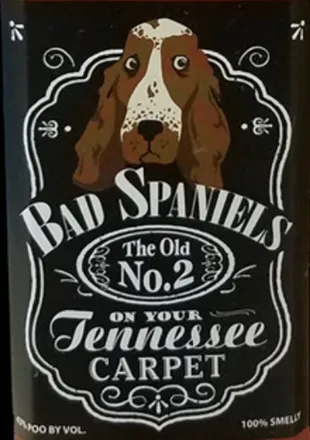
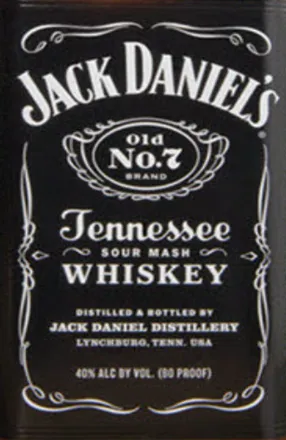
In the case, VIP Products LLC filed a trademark application for dog toys shaped like bottles with the element “Bad Spaniels The Old No. 2 on your Tennessee Carpet.” In response, Jack Daniel’s Properties, Inc. opposed the application on the basis of its “Jack Daniel’s Old No. 7 Tennessee Sour Mash Whiskey” trademarks, arguing that the contested sign made explicit reference to its iconic whiskey bottle “public image” and trademark identity. Thus, Jack Daniel’s Properties, Inc. contended that the contested application appropriated the “public image” associated with its trademarks.
In a unanimous decision, the Court held that the lower court had erred in dismissing the trademark infringement and trademark dilution claims through the application of the Rogers test, notwithstanding the fact that the contested sign incorporated prior expressive works associated with Jack Daniel’s Properties, Inc. The judgment was accordingly overturned, and the Court concluded that trademark infringement had occurred.
(Under the Rogers test, trademark infringement claims are dismissed, prior to any substantive similarity assessment, unless it can be demonstrated either that the contested sign bears no genuine artistic or analogous relevance to the prior right, or that it explicitly misleads consumers as to the source or origin of the trademark.)
In the said decision, the Court reasoned that, where a prior trademark is itself used by a third party as a trademark, as in the present dispute, the likelihood of consumer confusion reaches its highest level, thereby rendering the application of the Rogers test inappropriate.
Accordingly, although VIP Products LLC’s parody use could still be taken into consideration within the broader likelihood of confusion analysis, the Court held that such parody would not automatically preclude or neutralize the risk of trademark dilution. On this basis, the earlier judgment dismissing the infringement claims was overturned.
Source
(For the decision: https://www.oyez.org/cases/2022/22-148 )